Showing posts with label food. Show all posts

Thursday, October 04, 2012

Indonesian Cooking Class

One thing I have really enjoyed doing over the past 4 years has been taking cooking classes with CHIC. I have taken Persian, Mexican, Japanese, Indian, fusion, and baking classes. This week I was able to take a new class –– Indonesian!
 One of the early trips our family took was to Bali and we absolutely loved the food, so I thought this would be a good opportunity to learn how to make some of our favorites at home. While I did not learn how to make Matt's favorite Indonesian recipe, Nasi Goreng, I did get to try first hand in making four other recipes.

First up was Kari Ayam, an Indonesian chicken curry.  This recipe was full of many flavorful spices––  cardamon, cumin, star anise, coriander, turmeric, ginger and curry powder –– along with chicken, shallots and potatoes. Sadly, the recipe also included coconut milk, which I am allergic to, so I only was able to take a small taste before having to scratch the hives on my hands.

The chicken was sauteed in all the yummy spices before adding the coconut milk.
This dish, best served over rice, is totally up Matt and Chris's alley. (Like father like son!)
Next up, was our personal family favorite, Chicken Satay.  It started off making the peanut sauce and ending grilling the chicken skewers right on the stove. This will be a must try at home.

First we had to brown raw peanuts for the sauce.
After browning, we ground the peanuts and added sugar, lime, salt, chili powder, water and kecap manis (a dark sweet soy sauce). This all went on the stove to cook until thick and bubbly.
Next you take some of the sauce, along with some more kecap manis, chili sauce and sweet chili sauce, and marinate cut up chicken pieces. You then skewer them and grill.
 Serve with the peanut sauce and you have an awesome dish.
The third dish we made was Gado Gado, an Indonesian salad. This was by far the easiest dish. Basically you steam any vegetable you like, hard boil some eggs, cut up some tomatoes, carrots, lettuce and atsu-age (thick, fried tofu) and put them on a plate. Serve with peanut sauce and you are done.
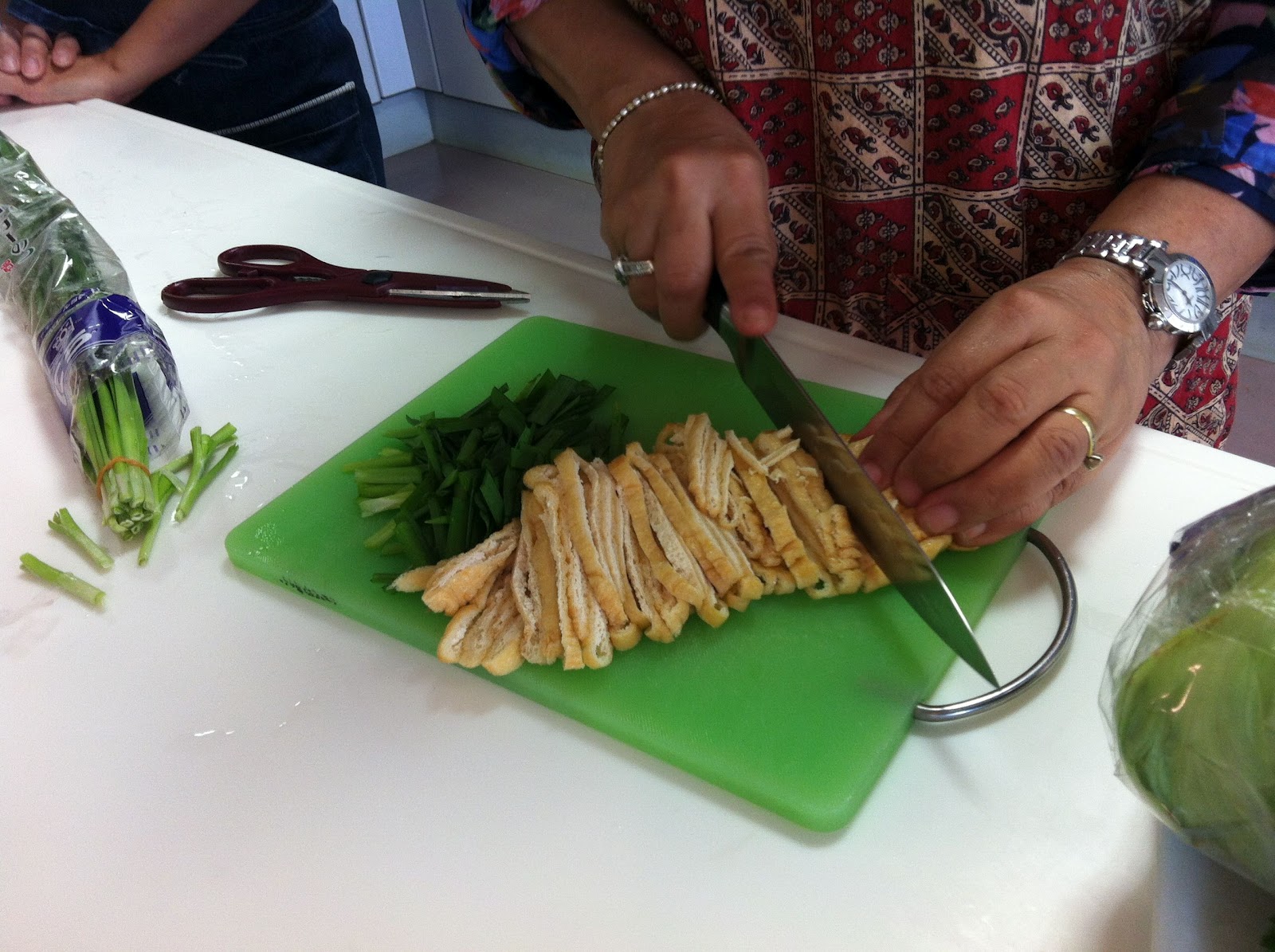
 Last, we made Vietnamese Spring Rolls. While this dish isn't specific to Indonesia, who can't help but love spring rolls? The inside of the rolls is a mixture of abura-age (thin fried tofu), cucumber, spring onions, lettuce, shiso leaves and glass noodles.
All these items are then rolled in rice paper. The rice paper is quite tricky and as you can see, I need much more practice. 
The spring rolls are best served with sweet chili sauce. Yum!
After 2.5 hours of learning how to cook these recipes, we finally were able to sit and enjoy ourselves.
 I've signed up for two more cooking classes in November–– Persian and Cajun. I can't wait.

Tuesday, November 23, 2010

Just Any Other Day

It is very strange living in a country where there is really no understanding of the American Thanksgiving holiday.  Families gathering together to stuff themselves full of turkey, more carbohydrates than one can even count, and sweet desserts until their stomachs almost explode, is quite a foreign concept to most non-Americans. But Thursday here in Japan, is just like any other day. The kids will go to school. Matt will go to work. And I will go about with my normal routine.

I really thought my first holidays living overseas and being away from family would be the hardest. But I was wrong. Maybe it is because I have so many fun Thanksgiving memories with my family and it is one of my favorite holidays (how can a holiday that you eat until you vomit NOT be a favorite?), but I find this year just as hard, if not harder. With the time change in the States (Japan's time does not change), and now being 14 hours time difference, talking with my parents is more difficult. My brother just got engaged to an awesome girl who I can't wait to have as part of our family. I have six nieces and nephews who will be running crazy, high on sugar, who will be a whole year older when we come back for home leave. Holidays are meant to be spent with family, and it is hard when family is on the other side of the world.

So what we have to do is make our own family and own memories here. It seems Thanksgiving is something many of us Americans miss, so people make their own "Thanksgiving Dinners'. Last weekend we went to a big Thanksgiving meal out at a neighborhood where several CAT families live. Great company and great food always is a reason to smile. This Saturday I am attempting to host 3 other families for our own big Thanksgiving. I am extremely a wee bit nervous as I haven't made most of the items on my menu since living in Japan and I am cooking two turkeys.  Don't worry I already have Thai delivery on my phone's speed dial. 

The hard part about creating your own family in an expat life is most of the people are transient. Meaning the people you develop friendships with will most likely move on at some point in time, whether it be before or after you. And many times, you will never see these "family members" again as they may live on the opposite side of the world from you.

So for all of you spending this Thanksgiving with your family, say an extra "Thanksgiving blessing" for the opportunity you have to spend this year with them –– no matter how crazy or dysfunctional the day may be. There are so many people, whether it be living some distance from family, missing a loved one who may have passed, or have other reasons why they cannot be with their family, who wish they could be spending the day the same way.

Thursday, November 18, 2010

Just Call Me a Food Hoarder

A few entries ago I talked about the challenges with cooking and baking in Japan. With these challenges it is very common for expats to bring back "unable to find" from their home country when they return from homeleave. They also place orders with importing stores, such as FBC and Expat Express.

We brought back a suitcase full of baking items, wheat thins, cereals, granola bars, etc when we came back to Japan in August. Last month a few of the other expats and myself went in together and split a case of canned pumpkin and white chocolate chips shipped from the United States. Then last week a few of us discovered cheap shipping from Flying Pig Imports and ordered cereals and a few other items.

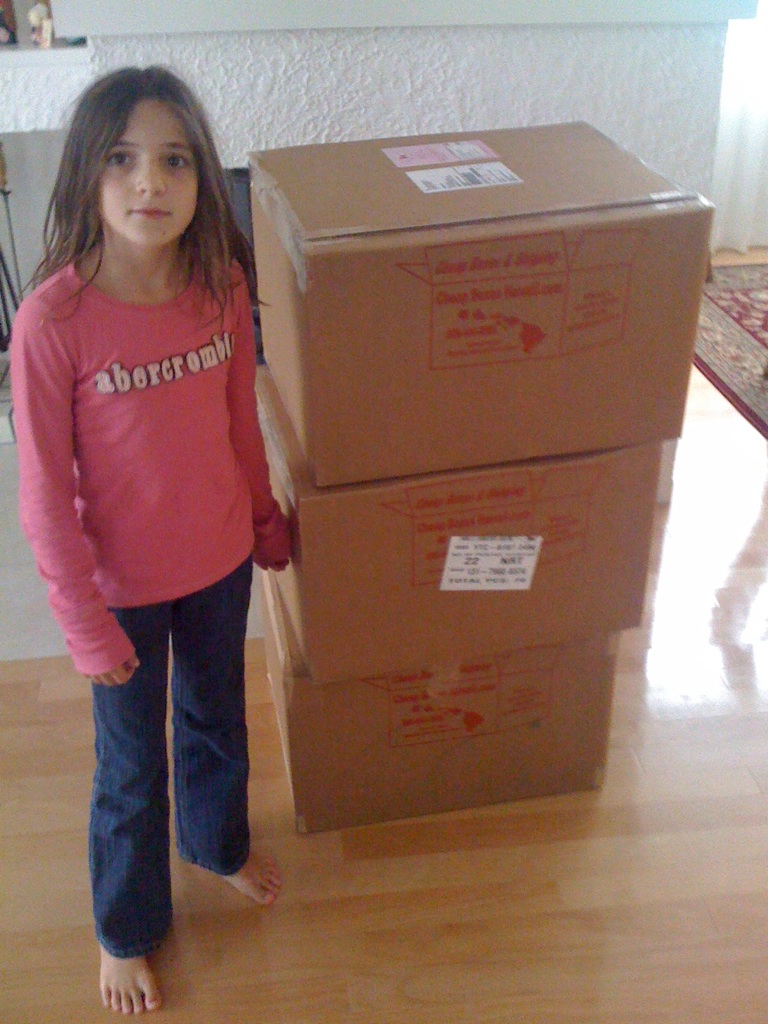
The boxes were delivered last Saturday while I was volunteering at the CHIC Holiday Bazaar. Matt took this picture and sent it to my phone, along with the message "What the heck did you order now!".

Between stuff from this summer, my latest Costco run and these orders, my pantry may be a wee bit out of control overstocked.  Matt has sternly nicely told me Japan is not closing their stores, we will not be quarantined to the house for a year and the world is not running out of food, so I need to use up some of my stock before I put anything else in the pantry.  I have no idea why he would feel the need to tell me this.


Believe it or not, there is an order to that madness. I can tell you where every item is what all we have inside the cupboards. For some reason Matt doesn't think so.

Tuesday, November 09, 2010

Cooking/Baking in Japan

Back when I was in college I could barely make Jello or mac and cheese. Over the years I have grown to be pretty decent in the kitchen. I love to cook and bake. However since moving here I feel like I have had a whole new learning curve.

First, no matter how hard you try, there are just some items that you cannot find here.  Fresh jalapenos, spices like celery seed and cream of tarter, noodles, buttermilk, most cereals, rotel tomatoes, most cheeses, most salad dressings, biscuits, wheat and multigrain breads, and cool whip to just name a few.  Some of the items we can bring back in our suitcases after homeleave, and a few we can have shipped from the states (for a hefty cost), but mostly we just have to set some recipes aside until we return stateside.

Many of the Japanese brand items are just different than what we have in the states. For example, butter, flour, brown sugar, powdered sugar, sour cream, and yogurt all are a different consistency and taste than what we are used to. Sometimes it is trial and error to get our recipes to work with these items.  Other items may have the same name as a US product, but upon opening we find out it is something totally different. Italian salad dressing is one example.

As I have mentioned before, there are import stores we can get some items not typically found in a Japanese store, such as canned vegetables, pasta sauces, brownie and cake mix, chocolate chips, nuts and other baking items. However, all these items come at a price. I have not been able to figure Japanese flour out for baking so I buy a bag of Gold Medal flour –– for $10 USD a bag. Occasionally the import stores will have a loaf of frozen multigrain bread –– for $8. And when we can get items at the import store, many times they are not the brand we want. For example, you cannot find Nestle chocolate chips here, only Hershey's.

I have to say, in some ways the challenges have been good. I have been forced to try new recipes, expand our menus, experience some different international foods, and cook more from scratch. Prepackaged, low fat and processed foods are not common here. And even though I have lived here almost two years now, there are still days I find myself banging my head on the kitchen counter because I just spent $30 for something that totally flopped and is uneatable. Or I really want to make a certain recipe to realize there is just no way to find all the ingredients.

So the next time you are walking through a grocery store take time to stop and "smell the groceries".  Then email me so I can live vicariously through you ––  just for a few moments.

Sunday, June 06, 2010

How to Make Onigiri -- Sami Style

Onigiri is a staple food in the Japanese diet. An onigiri is a white rice ball (although it is usually triangular shaped), sometimes filled with some type of tuna, salmon, plum or other salty or sweet treat. Onigiri is often wrapped in nori (seaweed) or mixed with beans and/or mushrooms. You can walk into any convenience store and find a wide variety of onigiri. While we Americans would typically walk into a convenience store and buy a candy bar, a Japanese person would buy onigiri

Sami loves onigiri. She doesn’t like the ones with fish in them, but she does like the ones with plum, mushrooms, plain or with sprinkles. Someone suggested for me to buy Sami an onigiri maker set for her birthday.  You can find ones in all different shapes for kids. She was so surprised when she opened the box. 

She begged us tonight to let her make onigiri for her lunch. How could we resist? 
 First, you scoop the rice into the onigiri mold. 

Next, smash the rice down and pack in as much as you can. 

Press down the lid and hold for a few seconds. 

Press the little button in the back and eject the onigiri onto your plate or in your bento box. 

Lick your fingers when you think mom isn't looking. 


Our family likes the gomashiro (sesame seeds and salt) sprinkles so we added it to a few of the finished onigiri. As you can see we have the traditional triangle, bear, star, flower and heart. 


There you go. How to make onigiri –– Sami style!

Tuesday, May 18, 2010

Chuga chuga choo choo! All aboard the sushi train!

Matt and Emily are the seafood eaters of the family. Before moving to Japan I had a rule of not eating anything that couldn't live out of water.  However, after living here (I swear if it lives in the sea the Japanese will eat it), I have been trying a few sea creatures here and there.

Chris and Sami were with friends on Sunday, so Matt, Emily and I decided to try a place recommended to us called "Sushi Ro." This restaurant was what we like to call a sushi train. Basically small dishes with different types of sushi go around the room on a conveyor belt.  People sitting at the tables can pick and choose what they want to eat. Some dishes are labeled, others have pictures and some just come around and you have to guess what they are. (Considering we cannot read most of the Japanese writing we pretty much guessed at anything we tried)


After trying several dishes it was discovered that the yellow plates meant the dish contained wasabi.  Now I love wasabi. Matt and Emily, not so much. As my dad would say, no hair growth shampoo needed!  It will put hair on your chest. I guess it is quite an acquired taste.

Luckily, the restaurant had dishes that were not seafood. I tried pork, ham, vegetables and something I think was beef. There was also fruit and desserts.

I did try a few things with shrimp. I have discovered if cooked right I am okay eating it.  This was rice, shrimp and avocado with some onion on top.

Matt was in heaven. He loves seafood of any kind. He even likes nori (seaweed), which is another main staple in the Japanese diet.

I wouldn't say it was my favorite place to eat in Japan, but it was fun and different. I quite enjoyed pressing the buttons and trying to order items we thought looked pretty in the pictures in my half Japanese/half English speaking. And the best part of it all?  Almost all the dishes are only ¥105 (about $1.10).  And nothing was more than ¥280!

Sunday, February 21, 2010

Walk through the grocery store

Grocery stores in Japan are pretty similar to the ones in America, with one difference –– the food.

The deli consists of ready made foods, such as fried rice, yakisoba, tempura and yakitori, rather than any type of lunch meat or sliced cheese. (In fact, it doesn't exist here)
 

The produce section is beautiful. You will never find a bruised or ugly piece of produce on the normal shelf of a grocery store. The saleclerks pick through sections by hand making sure there is nothing less than perfect for sale. And while sometimes the produce can be expensive, the size and taste more than makes up for it. 


 Where we would typically find things like packaged lunch meat, sausage, bacon and hot dogs, we find things like tofu (soft, hard, silk, fried) and noodles (soba, ramen, lo mein). 


There are sections of beef, pork and chicken, but typically the section of seafood is bigger. In fact, one day I will have to just blog about the sea creatures people eat in Japan.
 
  
 In the regular aisles you will typical items like cleaning supplies, chips, salad dressings, sugars, breads, and frosted flakes cereals, however these items tend to be different than what we are used to. Then there are items like nori, miso and just about any seasoning to be thrown into rice. 


There are also sections of milk, juices, yogurts, limited cheeses, butters, ice cream, tea (lots and lots of tea) and coffee.  All of that combined is usually the size of the alcohol section.   While you can buy beer by the 6-pack, 12-pack or case, it is much more common to just buy by the can, and mix and match what you want. There is many times a small (and I mean small) selection of imports and then many different Japanese choices of beer and Chu-His. 


Items vary from store to store. But you can always count on one thing –– it will be crowded. 

Sunday, January 31, 2010

Persian Cooking Class

Last week I took a Persian cooking class offered through CHIC. The Persian cooking classes are always quite popular because the person who teaches the class does a great job and because Persian food isn't something you run into in everyday cooking.

The class is hosted in the teachers house. Since many of the spices used in Persian cooking are not common, Nazie, the teacher, takes a few minutes to explain each of the spices and how they are used. The dishes we made that day used dried limes, saffron (a common spice used in Persian cooking), turmeric, and advieh (a mixture of 7 different spices).


The menu consisted of Salad-e Shirazi (a cold tomato and cucumber salad), Koresht-e-Ghaymeh Bademjan (a "stew" dish), yogurt dip, and crunchy basmati rice. It takes over 4 hours of cooking time for the stew when done properly. Needless to say, I won't be making this dish everyday!

After all the food was done we moved into the living room to enjoy all the awesome food.

And no meal is complete without a little something to wash all that fantastic food down.

The Salad-e Shirazi is super easy to make and something I eat for lunch quite often.

4 medium tomatoes
2 small cucumbers
1 medium onion ( I like red onion)
3-4 tablespoons fresh lemon juice
2-3 tablespoons virgin olive oil
200 grams fresh mint (or 1 teaspoon dry mint)
1/4 teaspoon salt
1/6 teaspoon black pepper

Wash cucumbers, tomatoes and mint. Peel onion. Chop cucumbers, tomatoes, and onion very finely, and mix. Chop mint very finely and add to the vegetables. Add fresh lemon juice, olive oil, salt, and black pepper.

Mix well and serve cool. If you want jazz it up a bit you can add feta cheese and black olives and eat with pita bread. YUM!